MOVING SCULPTURE AND PUBLIC ART: WHAT GALLERIES AND COMMISSIONERS NEED FROM A HAULAGE PARTNER

Moving a sculpture is not the same as moving a load.
The distinction matters more than it might first appear. A load has a weight, a dimension, a destination. A sculpture has all of those things — and also a material with specific structural properties, a centre of gravity that may bear no obvious relationship to the piece's outer form, a surface that cannot be touched in the wrong place, and a value that is frequently impossible to replace.
The question an arts organisation, estate manager or public art commissioner needs answered is not simply "can you lift it?" It is: do you understand what you're lifting?
After 25 years working with galleries, auction houses, private collectors and public art bodies across the UK — including Chatsworth House, the National Trust, Messums Wiltshire, Dreweatts, Coade Stone, Talisman Fine Arts London, Ken Bolan Studio and Summers Place Auctions — this is what we've learned about what the sector actually needs from a haulage partner.



The Difference Between Haulage and Handling
Most crane-assisted haulage ends when the lorry leaves the site. The load is down, the paperwork is signed, the job is done.
Fine art and sculpture work rarely ends there.
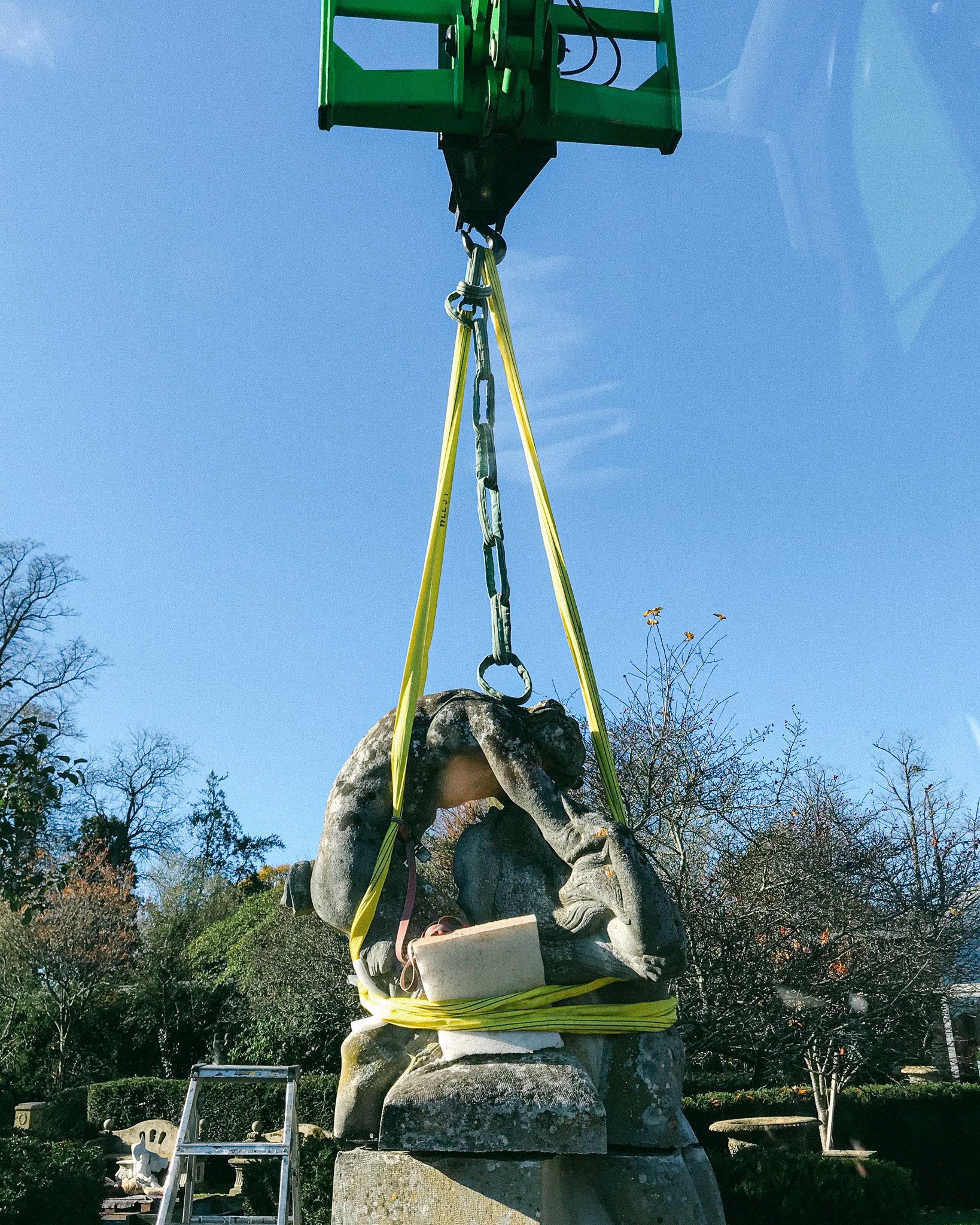
Getting a piece to site is one part of the operation. Getting it from the lorry to its final position — through a doorway, across a stone floor, up a flight of steps, onto a plinth, into a niche designed specifically for it — is often the more demanding part. And it requires a different set of skills, tools and judgment entirely.
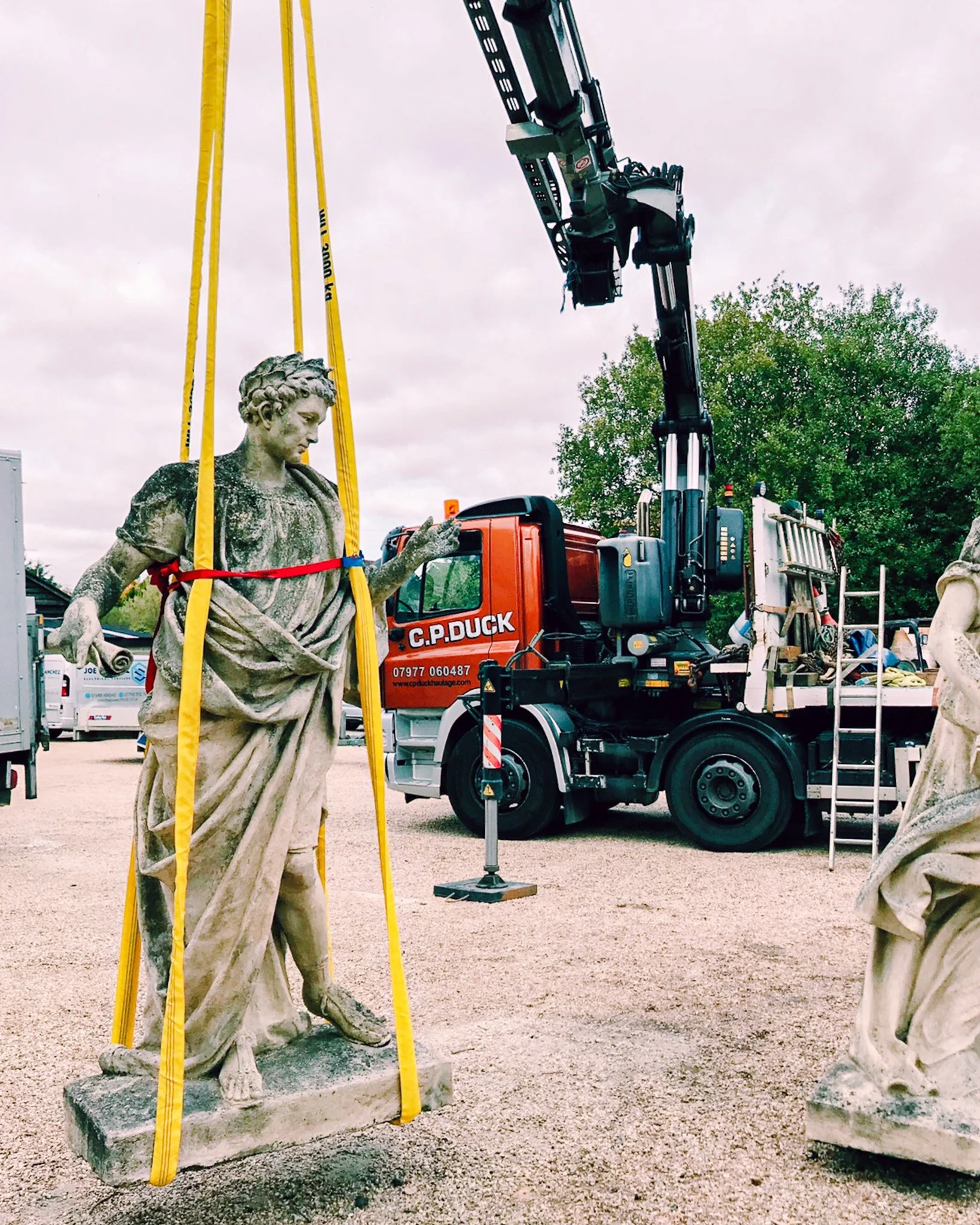
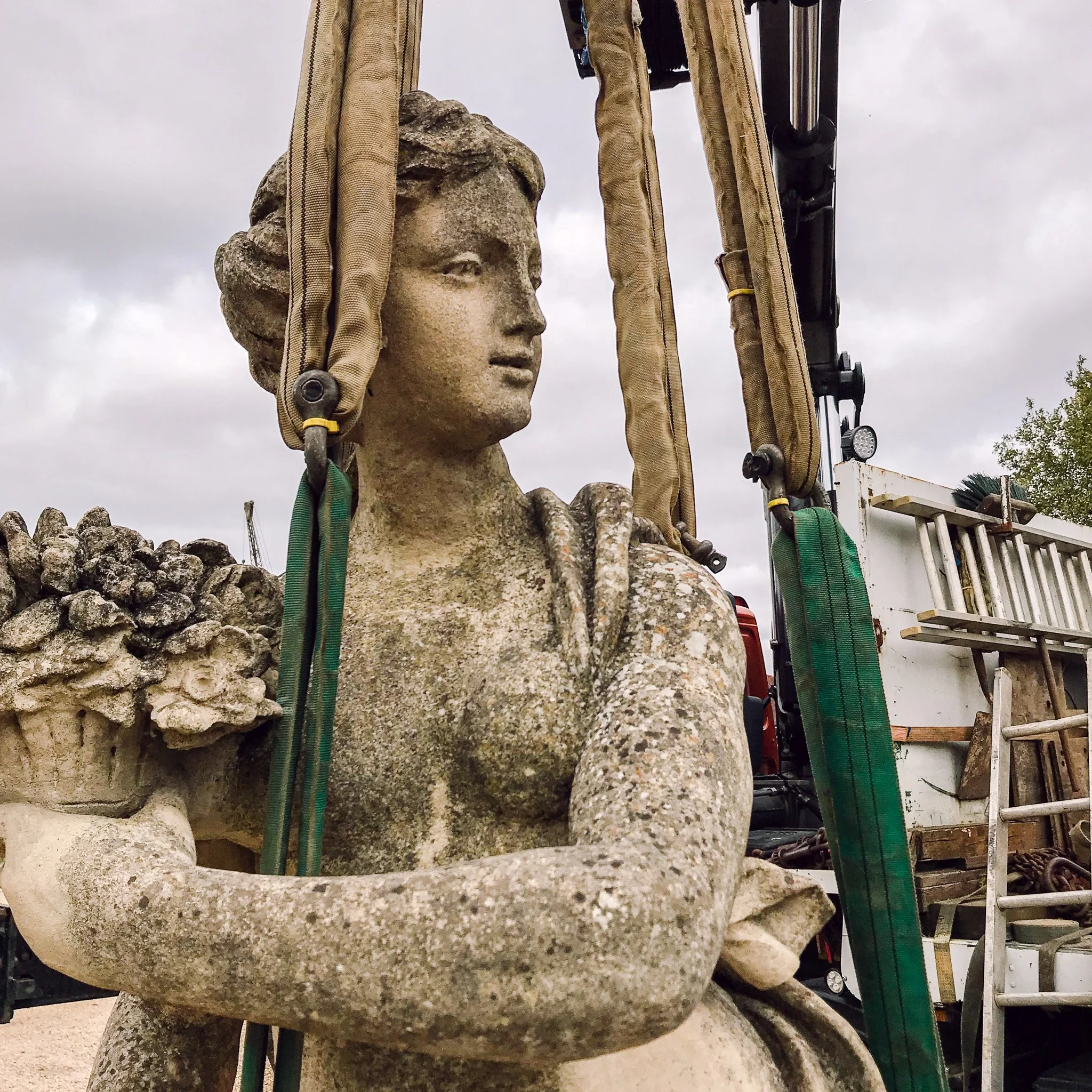
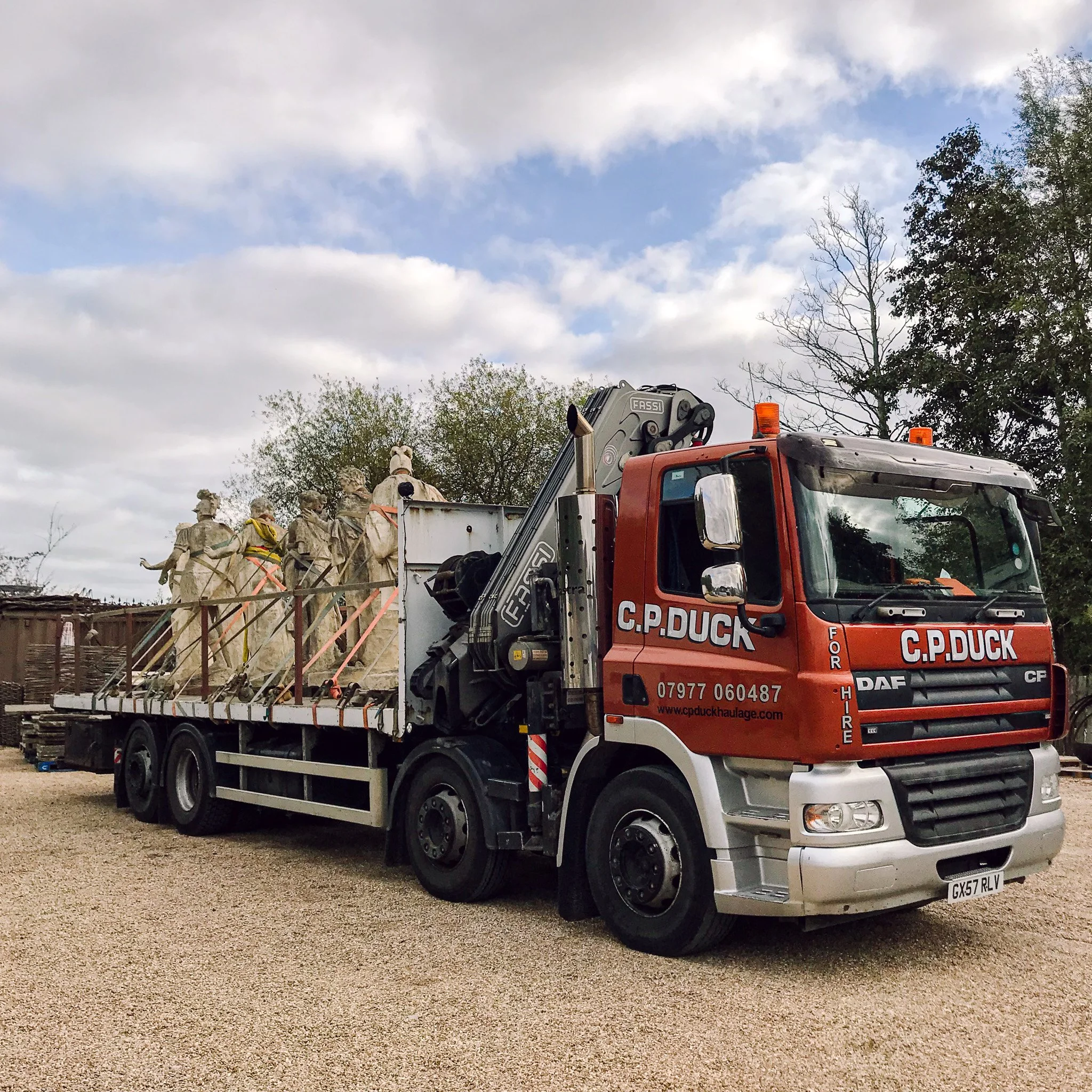
On a typical sculpture installation we might use the crane lorry for the primary lift, then transition to lifting frames, roller skates, manual skates, fork extensions, chain blocks, and pure manpower for the final positioning. Every transition is a moment of risk. Every surface the piece crosses has to be assessed and protected. Every decision about how to rig, angle, tilt or slide the work has to be made by someone who understands what the material will and won't tolerate.
That's not a process that can be improvised on the day. It has to be planned by people who've done it before.

Understanding Material — Why It Changes Everything
Two of the most common materials we work with in fine art haulage are bronze and marble. They couldn't behave more differently under load.
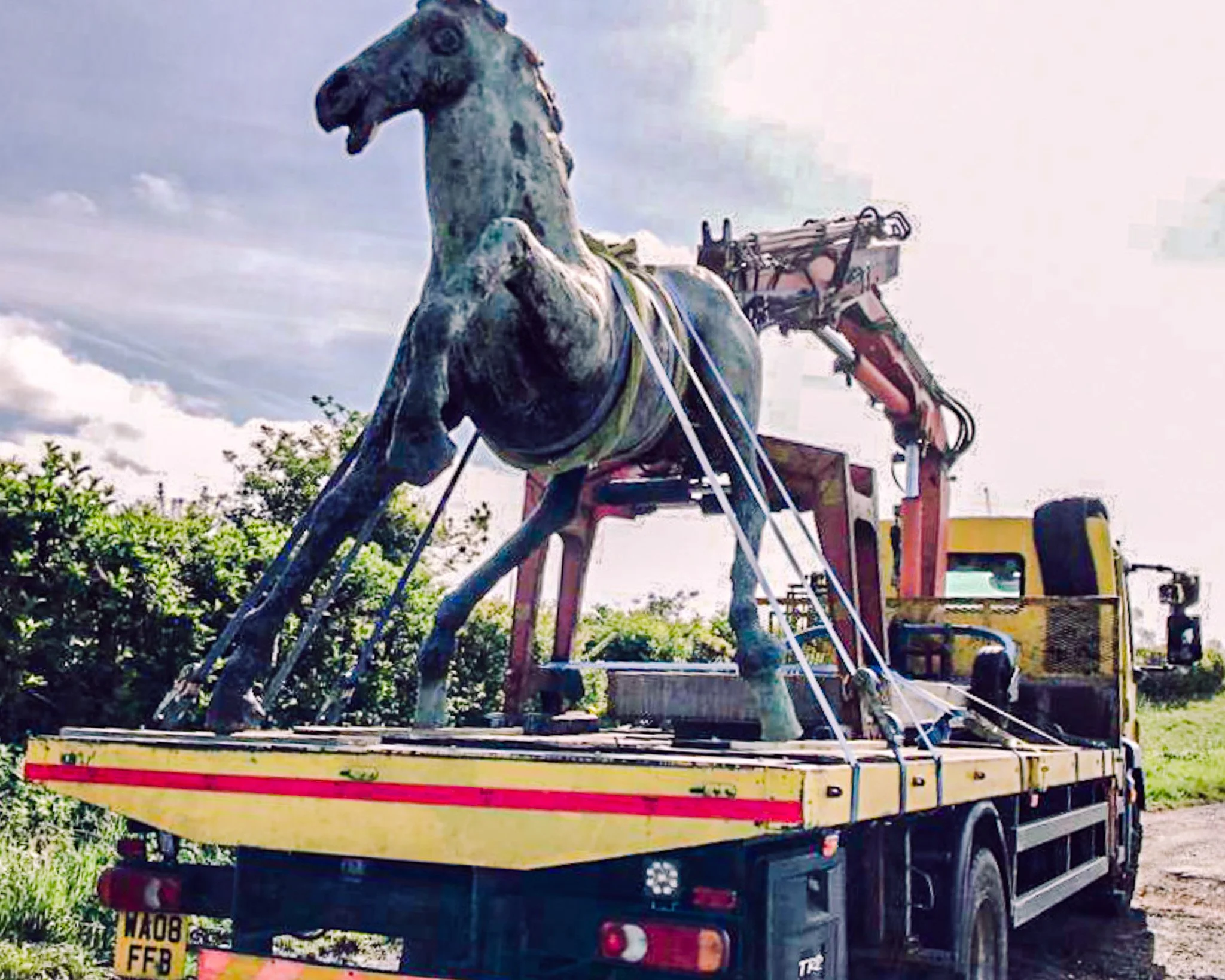
Bronze is extraordinarily heavy — denser than most people expect. A figurative bronze of modest apparent size can exceed a tonne. The challenge with bronze is rarely structural fragility — the material is robust — but rather the relationship between visible mass and actual centre of gravity. A figure leaning forward, a outstretched arm, an asymmetric form — the centre of gravity may sit nowhere near the geometric centre of the piece. Rig it incorrectly and the piece will want to rotate the moment it leaves the ground. Understanding where a bronze will hang before it's lifted is the difference between a controlled lift and a dangerous one.
Marble requires a completely different approach. Unlike bronze, marble is brittle. It does not bend — it fractures. And it will fracture under stresses that are invisible to the eye: uneven support across a base, vibration during transport, contact with a surface that concentrates load at a single point. Marble must be supported evenly and completely. It must be packed to eliminate movement without creating pressure points. It must be handled without shock. A crack in a marble piece is not a repair — it is a permanent alteration to the work.
Other materials — sand stone, Coade stone, terracotta, glass, resin, ceramic, painted or gilded surfaces — each have their own requirements. The common thread is that the person responsible for the move needs to know what those requirements are before the piece is touched, not after something goes wrong.


Discretion as a Professional Standard
A significant part of our sculpture and fine art work is for private clients — high net worth individuals, collectors, and estates where discretion is not a preference but a professional obligation.
These clients are not moving a hot tub. They are moving something that may have been purchased privately, that may represent a significant proportion of an estate's value, and that will be received at an address where the staff, not the client, will be managing the installation. The haulage partner in these situations is, for the duration of the job, a representative of the collector's standards.
That means arriving at the agreed time. Treating every member of staff — from estate manager to housekeeper — with respect. Working quietly and without disruption to the household. Leaving the property exactly as found. And never discussing the work, the client, or the piece with anyone outside the operation.
We work directly with the teams that manage significant private collections. We do not discuss those relationships publicly beyond confirming that they exist and that discretion is absolute.
Working With Auction Houses and Galleries
The auction house and gallery environment operates on its own rhythms — sale dates, viewing periods, installation deadlines — and the haulage partner needs to understand and accommodate those pressures.
We work regularly with Messums Wiltshire, Dreweatt Neate, Talisman Fine Arts in London, Ken Bolan Studio and Summers Place Auctions, among others. Each relationship is built on the same foundations: reliability, communication, and the understanding that when a piece needs to be somewhere by a particular time, that isn't a preference — it's a professional commitment.
For galleries and auction houses, the specific requirements tend to include:
Pre-move survey For any significant piece or complex installation, we walk the route in advance. Doorway widths, floor surfaces, threshold heights, turning radii — anything that could create a problem on the day is identified and planned for beforehand. This is not a courtesy. It is a professional requirement that any serious fine art handler should offer as standard.
Written method statement How the piece will be rigged, lifted, transported, unloaded and positioned. What equipment will be used at each stage. Who is responsible for each decision. This document protects the gallery, the auction house, and the collector — and it demonstrates that the person carrying out the work has thought it through properly.
Appropriate insurance Standard goods-in-transit insurance is not fine art insurance. We carry appropriate cover for the work we undertake and can confirm coverage specifics before any job is agreed.
Single point of contact In fine art work, communication failures cost money and cause damage. One person who knows the piece, knows the site, knows the plan, and can be reached at any point during the operation. That is always Chris Duck — the founder, the operator, and the person on the lorry.


Public Art Installation — Scale, Access and Community
Public art commissions present a different set of challenges again. The pieces are often large — sometimes very large — the sites are frequently in public spaces with significant access constraints, and the installation is often a public event whether it's intended to be or not.
Giles Penny's Man on a Bench — installed with our involvement — is a work that sits in plain sight in a public space. The installation required precision placement, careful coordination with the site, and a team that understood the significance of what was being installed without treating it as a performance.
At Chatsworth House, we worked on the installation of a feature for the south lawn pond — a project that required operating on and around one of the most significant private gardens in England, with all the care for ground conditions, historic structures and horticultural sensitivity that entails.
For public art commissioners, our involvement typically begins well before the installation date. Access routes onto the site, ground bearing capacity, overhead constraints, proximity to listed structures, coordination with local authority traffic management where required — the logistics of a public art installation are a project in themselves. We plan them as such.

What to Look for in a Fine Art Haulage Partner
If you are commissioning a public artwork, managing an estate collection, or placing a significant piece with a gallery or auction house, these are the questions worth asking of anyone you're considering for the haulage:
-
Experience with architectural salvage or garden ornaments is not the same as experience with contemporary sculpture or fine art. Ask for specifics.
-
Can they articulate, without prompting, what bronze does under load, why marble needs even support, what a painted or gilded surface requires in terms of packing and contact? If they can't answer these questions, the education will happen at the expense of your piece.
-
In fine art haulage, the separation between planner and operator is a risk. The person who surveys the site, writes the method statement and agrees the approach should be the person on site when the piece moves. At C.P. Duck Haulage, that is always Chris.
-
The crane lift is often the straightforward part. What is their plan for the final positioning — across a threshold, up steps, onto a plinth? What equipment do they carry? Have they done it before?
-
A piece that's heavier than specified. A doorway that's narrower than the survey suggested. A change of mind about final placement after the piece is already in the building. The quality of a fine art haulage partner shows most clearly in how they respond when the plan meets reality.

A Note on Scale
We are a small company. Two lorries, a core team, a founder who still drives and still operates the crane on every significant job.
For some commissioners, that raises a question about capacity. It shouldn't — but it's worth addressing directly.
The jobs we have described in this post — Chatsworth, the National Trust, Messums, Dreweatt Neate, private collections of national significance — were not won because we are large. They were won because the person managing the operation understands the work and takes personal responsibility for its outcome.
For fine art and sculpture haulage, scale of operation is largely irrelevant. What matters is whether the person making decisions on the day has the knowledge, the equipment, and the judgment to make the right ones. A larger company does not guarantee that. A smaller one — where the founder is on every job — often does.
Planning an Installation or Commission?
If you're coordinating a sculpture installation, managing a collection move, or working with a piece that requires specialist handling — we'd welcome a conversation at whatever stage is useful.
Early involvement in a project is always better than late. We can advise on access, ground conditions, rigging requirements and logistics before decisions have been made that are difficult to reverse.
📞 07977 060487
All enquiries handled with complete discretion.
C.P. Duck Haulage Ltd — Crane-Assisted Lifting & Logistics, Evercreech, Somerset. Est. 1999.
Also useful: What Is Crane-Assisted Haulage? | How to Choose a Crane-Assisted Haulage Provider